
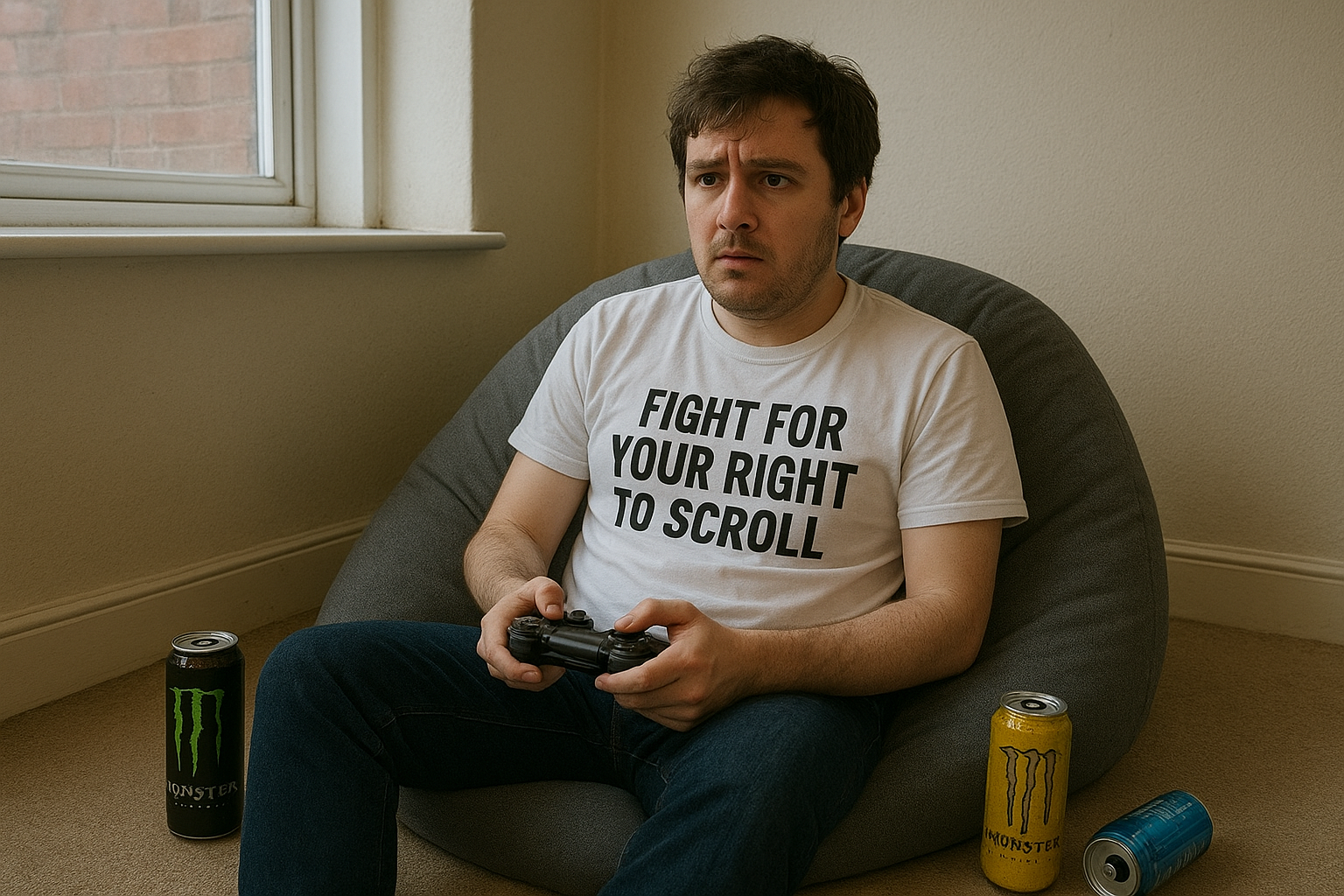
—And how he applied his expertise to outwit the machine.
I meet Jacob Standstill in his shop-top apartment on a quiet arterial road in Croydon, on the outskirts of London. “I thought my occupation was safe,” he says. Slumped in his beanbag with weary eyes, he continues, “But the computer is coming for me.”
Jacob is not alone. With AI replacing workers at an exponential rate, targeting the unemployed has become the logical next step. “This was meant to be our holdout against the machines. I got me a PhD in fine arts to future-proof me from the machine. Any attempt by AI to move in on my turf is blatant artistic forgery.”
Mark Van Wiping, lead engineer for AI Without Barriers, says the beta model produced surprising results. “Targeting the unemployed has thrown our model some philosophical dilemmas. What does an unemployed person look like to an AI?”
During testing, the first two people targeted were Jacob Standstill and Sam Bankman-Fried. From its perspective, it saw them as equivalent, two overweight men oozing their body odours into a beanbag. Meditation gurus, life-coaches and AI music tour managers also met a similar fate.
With the unemployed now in AI’s crosshairs, some non-workers are attempting to fight back. Jacob says, “We formed an online resistance movement for AI refugees to counter the encroachment of the machines on our way of being.” While the group’s Facebook page thumbs-ups are growing, the group’s most prolific posters were unaware they were in fact the AI moles infiltrating the resistance. In a rash decision, Jacob mandated that no members can use AI for posting messages on the group. Consequently, the plans for the resistance’s first meeting went silent.
Yet, AI analysts believe the group’s decision to not have a meeting was its first real win against the machine. “Logically, an online resistance does a Zoom call. And that’s exactly what AI expects them to do. But by doing nothing—like they always have, they may have just outsmarted the machine.”